Home Blog
Physical Security or Cameras: Which Is Better for Business Security?
Introduction
Business security is not one device, one security guard, or one camera at the entrance. It is a well-planned system in which each element has its own role. In one facility, high-quality video surveillance and clear access rules may be enough, while in another situation, physical security, regular patrols, visitor control, and on-site staff presence are required.
Company managers, office building managers, warehouse owners, construction site managers, and property managers often come to the same question: is it better to choose cameras, physical security, or both solutions together?
There is no simple answer, because every facility has its own risks.
In an office, visitor flow and access control may be important.
In a warehouse — the movement of goods, loading areas, and work outside standard working hours. On a construction site — machinery, materials, unfinished structures, and a changing site layout. In production or logistics facilities, both the movement of people and the flow of vehicles are important.
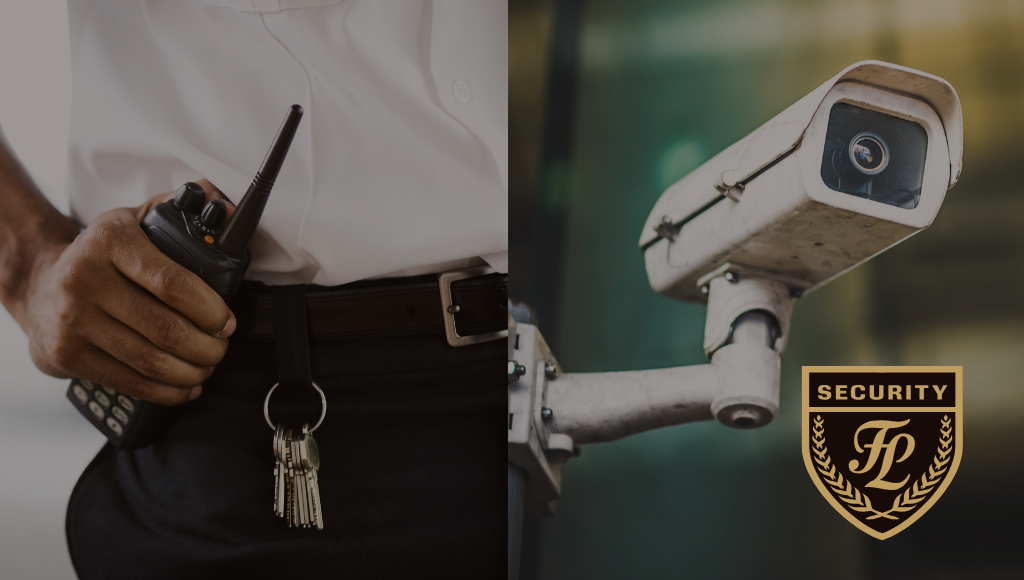
Cameras are a valuable security tool. They help monitor the territory, record events, and improve visibility. However, physical security provides what technology alone cannot always ensure — presence, assessment, response, and decision-making in a specific moment. That is why the most effective security solutions for businesses often combine both technology and the human factor.
Why Should Business Security Be Assessed Individually?
The choice of a security solution does not begin with the question “how much does it cost?”, but with the question “what exactly needs to be protected?”. Only after that is it possible to understand whether physical security, video surveillance, access control, or a combined approach would be more suitable.
Business security depends on several factors:
- the location of the facility;
- the size of the territory;
- working hours;
- the flow of employees and visitors;
- the amount of material assets;
- the number of access points;
- previous incidents or risks;
- the need to respond to situations on site.
For example, a small office with a limited number of visitors may be sufficiently protected with video surveillance, an alarm system, and electronic access control. However, for a facility where suppliers, clients, subcontractors, or vehicles regularly arrive, physical security may be much more practical.
Security should not be built on the principle of “the more, the better”. It is more appropriate to choose a solution that reduces risk in the specific facility and helps maintain order on a daily basis.
What Does Video Surveillance Provide for a Company?
Video surveillance is one of the most common security solutions for businesses. It allows events to be recorded, footage to be reviewed, and the territory to be monitored in real time or remotely. Cameras are often used in offices, warehouses, production facilities, car parks, construction sites, and common areas.
Well-placed cameras help to:
- improve visibility across the facility;
- record the movement of people and vehicles;
- review events after incidents;
- monitor areas where there is no permanent staff presence;
- support the work of security personnel;
- reduce the risk of unauthorized actions.
It is important to understand that cameras do not make decisions by themselves and do not physically stop an event. They help to see, record, and analyse. If there is no person at the facility who responds to the event, video surveillance may mainly serve as a tool for evidence and visibility.
This does not mean that cameras are ineffective. Quite the opposite — they are very useful when they are correctly installed, maintained, and included in a wider security system. However, companies need to know where the capabilities of technology end and where the need for human response begins.
When May Cameras Alone Not Be Enough?
Cameras help to see what is happening, but they do not always help resolve the situation at that exact moment. That is why there are facilities where video surveillance alone may not be enough.
This especially applies to situations where it is necessary to:
- verify a person’s identity;
- control entry or exit;
- stop an unauthorized person;
- assess suspicious behaviour;
- manage visitor flow;
- respond to a conflict;
- carry out territory patrols;
- check doors, gates, fences, or warehouse areas;
- ensure order outside working hours.
For example, a camera can record that a person is in an area where they should not be. However, physical security can approach the person, clarify the reason, check authorization, inform the responsible person, or act according to a predefined security protocol.
Similarly, video surveillance can show that a vehicle is standing at the gate, but a security guard can check the documents, coordinate entry, and make sure that the company’s procedures are being followed.
This difference is important. A camera observes. A person responds.
What Is Physical Security and What Is Its Role?
Physical security means the presence of a security guard at a facility with specific duties and responsibilities. It may include access control, territory patrols, visitor registration, monitoring vehicle movement, site security, responding to non-standard situations, and cooperation with company representatives.
Physical security is not just a “person at the door”. A professionally organized security service helps maintain order, reduce risk, and improve day-to-day security management.
A security guard at a facility can:
- control who enters and exits;
- check passes or permits;
- monitor the condition of the territory;
- respond to suspicious behaviour;
- carry out regular patrols;
- record events in a logbook;
- report to responsible persons;
- work together with technical security systems;
- help in emergency or non-standard situations.
It is precisely the human ability to assess a situation that makes physical security especially important at facilities where conditions change, the flow of people is intensive, or practical on-site action is required.
When Can Physical Security Be More Suitable?
Physical security can be more effective in specific situations, especially when active control and regular human involvement are needed at the facility.
It may be suitable in the following cases:
- There is a high flow of people at the facility
If employees, clients, suppliers, couriers, and subcontractors enter the facility on a daily basis, it is important to understand who is on the premises or territory, when they are there, and for what purpose. In such cases, access control is essential. - Vehicle movement must be monitored
Warehouses, production areas, and logistics facilities often work with freight transport. A security guard can check documents, register entry and exit, and help maintain order at the gates. - There are valuable materials or equipment at the facility
Construction machinery, tools, goods, raw materials, and equipment are often important assets for a company. Physical security helps control access to these areas and carry out patrols. - The territory is large or complex
In large territories, cameras may not cover every corner. Even if they cover most of the area, human patrols help notice details that a camera may not show clearly enough. - On-site response is required
If a situation requires immediate action, a security guard can respond according to a defined procedure. This can help assess the event more quickly and inform the responsible persons.
Why Is the Best Solution Often a Combination?
For many companies, the most practical solution is not choosing between cameras and a security guard, but combining both approaches. Video surveillance helps to see more broadly, while physical security helps to respond more intelligently.
For example, a camera system may detect movement in a distant part of the territory. A security guard can check the situation, assess the circumstances, and act according to protocol. Likewise, a security guard can use camera footage to monitor several areas more effectively at the same time.
A combined approach helps to:
- improve visibility across the facility;
- notice non-standard situations more quickly;
- reduce “blind spots”;
- use the security guard’s time more efficiently;
- record events and respond at the same time;
- adapt the security system to the specifics of the facility.
It is important to remember that no solution guarantees 100% security. However, a correctly chosen system can significantly reduce risk, improve control, and help the company feel more confident in its day-to-day operations.
How Can Feratum Life Help?
The security company Feratum Life helps businesses assess their facilities and find a security solution that matches their specific situation. The goal is not to offer one universal model for everyone, but to understand the specifics of the facility and recommend a practical approach.
A company may need physical security, video surveillance, access control, or a combination of several solutions. A professional consultation helps determine what will be most suitable for a specific office, warehouse, construction site, production area, or managed property.
Feratum Life’s approach is based on clear questions:
- which risks are the most important at the facility;
- what the daily flow of people and vehicles is like;
- which security solutions are already being used;
- where physical presence is needed;
- where technology can help improve visibility;
- how to ensure practical and understandable security work.
This approach helps a company make a considered decision instead of choosing a security solution based on guesswork.
Frequently Asked Questions
Can cameras replace physical security?
In some facilities, video surveillance may be sufficient, especially if the risk is low and no on-site response is required. However, in situations where access control is needed, where it is necessary to respond to people’s behaviour, or where the territory must be monitored in person, physical security may be more suitable. It should be understood that cameras cannot replace an immediate physical security response.
Does physical security guarantee complete safety?
No, no security solution guarantees 100% safety. However, physical security helps significantly reduce risk, improve control, and ensure human presence in situations where on-site action is required.
When does a company need access control?
Access control is important when employees, clients, suppliers, subcontractors, or vehicles enter the facility. It helps clearly define who is allowed to be in specific areas.
Are cameras enough for warehouse security?
That depends on the warehouse’s operating mode, the value of the goods, the vehicle flow, and the access points. In many cases, warehouse security is more effective when video surveillance is combined with physical security.
How can I understand which solution is right for my company?
The best way to start is with a security consultation. A specialist assesses the facility, risks, flow of people, access points, and existing security solutions in order to recommend the most suitable approach.
Conclusion: Security Starts with a Well-Considered Choice
Physical security and cameras are not competitors. They are two different security tools that work best when used in the right place and in the right way.
Video surveillance helps improve visibility, record events, and monitor the territory. Physical security helps respond, assess the situation, control access, and maintain order at the facility. A combination of both solutions often provides the most practical and balanced approach for a company.
Business security should not be based on guesswork. It should be built around the needs, risks, and daily working rhythm of the specific facility. That is why a professional security consultation can help make a clear and well-founded decision.
If you want to understand whether physical security, video surveillance, access control, or a combined solution is more suitable for your facility, contact Feratum Life.
Apply for a security consultation and assess which security services will best help improve your company’s security.
Contact us:
Mobile: +371 27788250
Email: feratum.life@inbox.lv, info@feratum.life