Home Blog
How can security help event organisers avoid reputational risks?
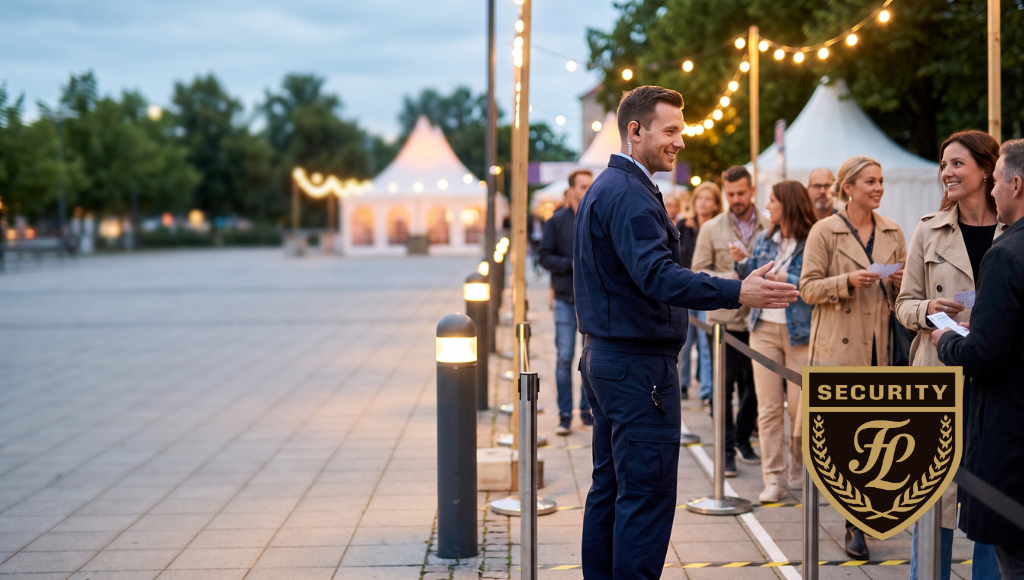
A successful event is usually remembered for its atmosphere, high-quality programme, interesting people, and the feeling that everything ran smoothly. Behind this apparent simplicity, however, there is often careful planning — including professionally organised event security.
Security becomes particularly important at corporate, client, and brand events. If something goes wrong, the consequences may extend far beyond a single dissatisfied guest. A video of a conflict can reach social media, a long and chaotic queue can become the main talking point, and inappropriate conduct by a security officer may be directly associated with the event organiser or brand.
Professional security is therefore not merely a solution for situations in which an incident has already occurred. Its greater value lies in anticipating problems, reducing the likelihood of them occurring, and responding in a way that makes guests feel safe rather than controlled.
Event security is part of the guest experience
One interesting aspect of security is that guests may barely notice it when an event is well organised.
Entry is straightforward. People move through the venue without unnecessary congestion. Unauthorised individuals do not enter restricted areas. If a guest has a question, they receive a clear and courteous answer. Any problem is handled calmly and as discreetly as possible.
As a result, the guest is left with a simple impression: “This event is well organised.”
This is where security and reputation meet.
Even if the content of an event is excellent, poorly organised entry, aggressive communication, or chaotic action during an emergency may be what guests remember most.
This is particularly important at B2B events, conferences, corporate anniversaries, product launches, and other brand events. In these settings, the guest experience also becomes part of their experience with the company itself.
How can a security issue become a reputational issue?
Reputational risk does not always begin with a major incident. Sometimes, a series of seemingly minor organisational mistakes is enough.
Imagine a company conference attended by several hundred guests. A long queue forms at the registration area, it is unclear where VIP guests and other attendees should wait, people begin gathering around the entrance, and staff members provide conflicting instructions.
From a security perspective, nothing dramatic has happened yet. From the guest’s perspective, however, the event has already started badly.
Similar consequences can result from several risks:
- uncontrolled queues and overcrowding;
- conflicts between guests;
- unauthorised individuals entering the event or restricted areas;
- unclear rules and inconsistent enforcement;
- poorly managed VIP, stage, technical, or staff areas;
- an unprofessional response to an incident;
- unclear procedures during an evacuation or other emergency;
- rude, provocative, or excessively aggressive communication.
Today, almost any incident can also be recorded. On social media, audiences often see only a few seconds of what happened rather than the full context of the situation.
Organisers must therefore consider not only whether security personnel will be able to respond, but also how they will respond.
The main role of professional security is to prevent problems
Security work is often associated with physical intervention during a conflict or another incident. However, the objective of high-quality security management is to ensure that such intervention is required as rarely as possible.
This work begins before the first guest arrives.
The venue, expected number of guests, event format, entrances and exits, restricted areas, guest profile, and potential risks must all be understood. Based on this information, an appropriate security plan can be developed.
During the event, security personnel monitor the environment and respond to early warning signs.
If congestion begins to develop at the entrance, the flow of people can be reorganised before overcrowding occurs. If tension arises between guests, security personnel can attempt to de-escalate the situation before it develops into a physical confrontation.
This preventive approach is essential for both physical safety and reputation protection.
Access control — the first impression of the event
The entrance is often the first place where guests interact with event staff. Access control is therefore both a security matter and a guest experience issue.
Depending on the event, invitations, accreditation passes, wristbands, or other forms of authorisation may need to be checked. Public and restricted areas must also be clearly separated.
The access control process must, however, be easy to understand.
If one guest is asked to present their accreditation while another is allowed to pass without being checked, questions may arise about the quality of the organisation. Checks that take too long can also create queues and frustration.
For this reason, event security should be planned together with crowd flow, registration, and guest service rather than treated as a completely separate function.
Crowd management reduces both safety and reputational risks
A larger number of guests automatically creates additional organisational challenges.
Particular attention should be paid to entrances and exits, cloakrooms, registration points, stairways, narrow corridors, areas near the stage, and other locations where many people may gather within a short period.
The role of security is not simply to “stand by the door”. Security personnel must be able to recognise where congestion is beginning to form and work with the organiser to address it before it becomes a problem.
This is especially important at the beginning of an event, during breaks, and after the programme ends, when many people may want to move in the same direction at the same time.
Well-managed crowd flow feels natural to guests. Poorly managed crowd flow becomes noticeable almost immediately.
Unauthorised access can have serious consequences
At B2B and brand events, access control may also be important for confidentiality and the company’s image.
For example, some areas may be accessible only to speakers, employees, technical staff, media representatives, or VIP guests. An unauthorised person entering such an area can create both security and reputational problems.
Before the event, it should therefore be clearly established:
- who is authorised to enter each area;
- how their authorisation will be verified;
- what should happen if someone does not have the required access.
The less improvisation required in such matters, the more professionally the event will run.
Why is communication by security personnel as important as control?
One of the most important but sometimes underestimated aspects of security is how security personnel communicate.
During an event, a security officer also represents the organiser to a certain extent. Guests do not always distinguish between the security company and the company whose event they are attending.
If a security officer communicates calmly, respectfully, and clearly, even an uncomfortable situation can be resolved without unnecessary tension.
An authoritarian tone, unnecessary aggression, sarcasm, or a public argument, on the other hand, may only escalate the conflict.
A good example is a guest attempting to enter an area without the necessary accreditation. A professional response involves more than simply blocking their way. The security officer should clearly explain why access cannot be granted and, where possible, direct the guest to the appropriate person or location to resolve the situation.
The rule remains in place, but the person is treated with respect.
It is through these seemingly small interactions that guests form an impression of the organiser’s professionalism.
Clear incident procedures reduce chaos
Not every risk can be prevented.
A medical emergency, technical failure, conflict, suspicious situation, or the need to evacuate the premises may arise. In these moments, preparation becomes crucial.
If security personnel, organisers, and other responsible staff members do not know who is responsible for what, valuable time may be lost trying to coordinate the response.
Response scenarios and the communication chain should therefore be agreed before the event.
Who should a security officer notify about an incident? Who makes decisions? How are the emergency services contacted? Where are the emergency exits and assembly points? How will staff inform guests?
The clearer the answers are before the event, the less improvisation will be required at a critical moment.
Information about civil protection and emergency situations in Latvia is also available on the website of the State Fire and Rescue Service, while current legislation can be found on the Likumi.lv website of the Republic of Latvia.
How should risks be assessed before a B2B or brand event?
Effective event security begins with a risk assessment.
There is no single security model that works equally well for a small corporate seminar, an international conference, and a widely promoted product launch.
Before the event, organisers should assess the characteristics of the venue, expected number and profile of guests, number of entrances and exits, event duration, availability of alcohol, whether the event is public or private, the presence of VIP guests, technical and restricted areas, and any risks specific to the event.
The event programme should also be taken into account. Security requirements may change during different stages of the event.
For example, the largest influx of guests may occur during the hour before a conference begins, while the informal evening programme may introduce entirely different risks.
How many security officers are required?
This question should not be answered using only a simple formula such as “one security officer per specified number of guests”.
The number of attendees is only one factor.
The size and layout of the venue, number of entrances, number of controlled areas, expected crowd flow, event format, and level of risk must also be considered.
For example, if the main entrance, backstage area, VIP room, and an additional entrance must all be controlled simultaneously, these security posts already determine the minimum staffing requirement.
Larger events may also require mobile security personnel who are not stationed at one fixed location but instead monitor crowd movement and respond to situations in different parts of the venue.
The required number of security officers should therefore be determined through an assessment of the specific risks and functions, while also complying with the applicable legal and venue requirements.
Professional security should not disrupt the event
There is another important consideration: security measures should be proportionate to the environment.
A corporate conference, luxury brand presentation, and public concert will each have a different atmosphere and therefore require a different type of security presence.
In some cases, organisers need a clearly visible security presence. In others, discreet supervision that does not affect the atmosphere of the event may be more appropriate.
Professional security personnel can adapt their approach to the specific environment while maintaining the necessary level of control.
This is especially important at brand events, where every interaction with a guest — from registration to departure — contributes to their overall impression of the company.
Security planning is also reputation management
An organiser cannot guarantee that nothing unexpected will ever happen at an event. They can, however, be much better prepared.
Preparation is often what determines the difference between a minor incident that is handled professionally within a few minutes and a situation that develops into chaos and later becomes a reputational problem.
Professional security should therefore be involved early enough in the planning process. The better the security team understands the event format, guest flow, venue, and organiser’s priorities, the more accurately it can prepare.
In this sense, security is not simply a security officer stationed at the door. It is a system that combines risk assessment, access control, crowd management, communication, incident prevention, and clear emergency response procedures.
Frequently asked questions
Why is security necessary at a corporate event?
The need for security depends on the specific event and its risks. Professionally organised security can help control access, manage crowd flow, monitor risk areas, prevent conflicts from escalating, and ensure a coordinated response to incidents.
Can security affect a company’s reputation?
Yes. Guests may perceive the conduct of security personnel as part of their overall event experience. Calm and respectful communication creates a professional impression, while unjustifiably aggressive or disrespectful behaviour can negatively affect the image of the organiser or brand.
How should the required number of security officers be determined?
Organisers should consider not only the number of guests but also the venue layout, entrances and exits, number of controlled areas, nature and duration of the event, expected crowd flow, and identified risks. Any applicable requirements for the particular event and venue must also be taken into account.
Why is a security briefing necessary before the event?
A briefing helps everyone involved understand their responsibilities, the specific nature of the event, access rules, communication chain, and incident response procedures. This reduces uncertainty and the need for improvisation in critical situations.
Is the role of security limited to responding to incidents?
No. Prevention is a key function of professional security — identifying risks and taking action before they become serious problems. This may include managing crowd flow, controlling access, monitoring risk areas, and de-escalating conflicts at an early stage.
Conclusion — a safe event builds trust
A successful event allows guests to focus on the content, conversations, and overall experience rather than organisational or security problems.
This is why security should not be regarded merely as a mandatory expense or a solution for emergencies. Properly planned event security helps create an organised environment in which problems are identified early, crowd movement is controlled, and incidents are handled professionally.
This is even more important at B2B and brand events because the guest experience directly influences how the organiser is perceived.
Security planning should therefore begin during the event preparation stage: risks should be assessed, the necessary security resources identified, responsibilities assigned, and clear response scenarios prepared.
When the security team and organiser work as one coordinated system, everyone benefits — guests feel safe, the event runs more smoothly, and the organiser is better able to protect their reputation.
Contact us:
Mobile: +371 27788250
Email: feratum.life@inbox.lv, info@feratum.life