Home Blog
What to do if damage occurs at a property but it is unclear what caused it?
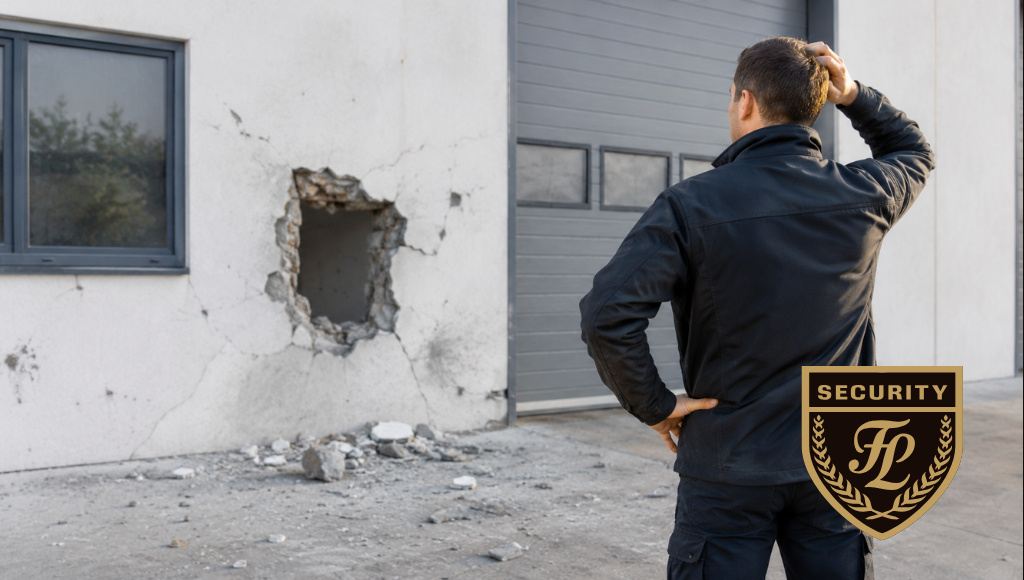
Damage at a property always creates an unpleasant situation. One morning, a damaged gate, a broken window, a damaged barrier, a scratched car, a broken door lock, or damaged equipment is discovered. The first question is usually: who did it?
However, in practice, the answer is not always obvious. This especially applies to parking lots, commercial properties, warehouses, office buildings, residential courtyards, and other areas where many people, vehicles, and delivery services move on a daily basis. If there is no clear incident recording procedure, no security reports, and no area patrols, determining the cause of damage can become complicated.
The good news? With the right actions, this process can be significantly simplified. In this article, we will look at what to do when damage is discovered at a property, how to properly document it, and why professional property security is one of the most effective ways to reduce the risk of similar situations in the future.
Why is it often difficult to determine the cause of damage?
In many properties, damage is not noticed immediately. For example, in a parking lot, a barrier may be damaged in the evening, but the property manager only notices it the next morning. In a commercial property, door damage may occur during a delivery, but no one has seen the exact moment. In a residential area, lighting or a fence may be damaged, but residents only say that “it was already broken.”
In such situations, the problem is usually not just the damage itself. The biggest issue is the lack of information.
Most commonly, uncertainty arises when:
- there is no regular security presence at the property;
- no area patrols are carried out;
- there is no defined incident recording procedure;
- damage is not documented immediately;
- there are no security reports on events at the property;
- surveillance cameras do not cover the entire area;
- it is unclear who was present at the property and when.
And this is where the real chain reaction begins. The property manager has to explain the situation to the owner, tenants, clients, or the insurance provider. The parking lot owner must handle customer complaints. A commercial property may face additional costs and reputational risks. Therefore, it is important not only to react after the fact but also to establish a system that helps clarify events as quickly as possible.
First step: immediately document the damage
If damage is discovered at a property, the first practical step is to document it. Not after an hour, not the next day, but immediately as soon as it is noticed.
Incident documentation helps preserve evidence and create a clear description of the event. This is especially important when later communicating with a security company, police, insurance provider, clients, or the property owner.
When documenting damage, it is recommended to record:
- date and exact time when the damage was noticed;
- location of the damage;
- a brief description of what exactly is damaged;
- photos from multiple angles;
- nearby traces such as tire marks, glass shards, or tool marks;
- information about the person who discovered the damage;
- possible witnesses;
- nearby cameras or access points.
The more accurate the initial information is, the easier it is to later understand what may have happened. Even a small detail can be important. For example, if paint traces from a vehicle are visible near a damaged barrier, they may help match them with a car seen in surveillance footage.
Second step: check surveillance and access data
If the property has surveillance cameras, they should be checked as soon as possible. In some systems, recordings are stored for a limited time, so delays may result in important data being overwritten.
However, one key point must be remembered: surveillance alone does not always solve the problem. A camera may be pointed in a different direction, the image may be too dark, a vehicle’s license plate may not be readable, or the incident may occur outside the field of view.
That is why surveillance works best together with other security solutions, such as security reports and regular area patrols. If a security officer has noticed a suspicious vehicle, open gates, or unauthorized persons during their rounds, this information can help narrow down the timeframe and possible cause of the incident.
In commercial properties and parking lots, it is also useful to check:
- entry and exit times;
- access card usage;
- delivery arrival times;
- employee shift schedules;
- security post logs;
- customer or tenant complaints during the relevant time period.
This type of information helps build a complete picture of the event. And as the saying goes, the picture becomes much clearer when every piece is in its place.
Third step: prepare a security report
A security report is one of the most important documents when damage occurs at a property. It is not just a formal piece of paper. A properly prepared report helps understand what happened, when it happened, and what actions were taken by security or responsible persons.
Professional property security usually ensures regular documentation of events. This may include daily patrol logs, emergency incident descriptions, and information about suspicious activities.
A quality security report should include:
- date and time of the incident;
- exact location of the damage;
- observations of the security officer or responsible person;
- actions taken;
- photo documentation, if available;
- information about involved persons;
- indication whether police or a responsible representative was called;
- recommendations for further actions.
Such a report is especially useful for property managers, as it helps clearly communicate with owners, tenants, and service providers. It can also be important for insurance cases, where it is necessary to prove that the damage was recorded and the situation was not ignored.
Why is area patrolling so important?
Area patrolling is one of the most effective ways to detect problems early. It is not just “walking around.” It is a systematic inspection of the property during which a security officer pays attention to risks, damage, suspicious individuals, and unusual situations.
Regular area patrols help to:
- detect damage faster;
- determine an approximate time when damage may have occurred;
- prevent vandalism and unauthorized presence;
- improve security in parking lots and commercial properties;
- reduce the risk of theft and property damage;
- ensure better control of the property outside working hours.
For example, if a security officer conducts rounds every hour and everything is fine at 22:00, but damage is noticed at 23:00, the timeframe of the incident is already much clearer. This significantly simplifies checking surveillance footage and identifying a potential offender.
Without patrols, damage may go unnoticed for hours or even days. Then it becomes much harder to determine what caused it.
Property security as a preventive solution
Many people think about security only after something has already happened. However, professional property security works best preventively. The presence of a security officer, regular patrols, and a clear incident documentation system reduce the risk of damage, theft, or unauthorized access.
Security presence is especially important in properties where:
- there is heavy traffic flow;
- customer or employee vehicles are present;
- valuable equipment or goods are stored;
- deliveries occur outside working hours;
- multiple tenants operate on site;
- the area is large or difficult to monitor;
- previous incidents have already occurred.
A security officer does not only react to events but also performs monitoring and control functions. They may notice open gates, damaged lighting, suspicious vehicles, or individuals present without a clear reason. These early signals often help prevent larger problems.
What should a parking lot owner do if property or a customer’s car is damaged?
Incidents in parking lots are often particularly complex. Vehicles, pedestrians, delivery transport, and sometimes unauthorized persons move through them regularly. If a car, barrier, fence, or payment system is damaged, it is very important to act quickly and thoughtfully.
Recommended actions for a parking lot owner or manager:
- Document the damage with photos.
- Record the exact time when the damage was noticed.
- Check surveillance footage.
- Identify which vehicles were present at the time.
- Review security reports and patrol logs.
- Inform the responsible person or owner.
- Contact police or insurance if necessary.
It is important to remain calm and avoid premature conclusions. The first suspicious vehicle is not always the culprit. That is why accurate incident documentation and objective data are essential.
What should a property manager do in a commercial property?
In commercial properties, damage can affect multiple parties at once: owners, tenants, employees, customers, and visitors. For example, damaged doors may create a security risk, a broken barrier may disrupt customer flow, and damaged lighting may increase the risk of accidents.
In such situations, the property manager must not only fix the damage but also clarify the circumstances. Otherwise, the same issue may happen again.
Practical actions in a commercial property:
- isolate dangerous areas if the damage poses a risk;
- inform the property owner or manager;
- document the damage with photos;
- check security and surveillance information;
- determine whether deliveries or visitors were present nearby;
- prepare a written incident report;
- assess whether additional security measures are needed.
This systematic approach helps avoid chaos. Everyone knows what needs to be done, information is collected in one place, and decisions are made based on facts rather than assumptions.
Incident documentation system: why it pays off
Incident documentation is not only for large companies or complex properties. It is necessary for any area where there is a risk of damage, theft, or conflict.
A good incident documentation system allows you to:
- understand what happened faster;
- reduce disputes between involved parties;
- provide evidence to insurance companies;
- improve the quality of security work;
- identify recurring problem areas;
- plan additional security measures;
- improve communication with clients and tenants.
For example, if vehicles are repeatedly damaged in the same parking area, it may indicate poor lighting, a too narrow exit, or insufficient control. Without documentation, the problem may seem random. With data, it becomes clearly visible.
How to reduce the risk of damage in the future?
Once an incident has been documented and initially evaluated, the next step is prevention. It is not enough to simply repair the damage and continue as before if there is a risk of recurrence.
To reduce the risk of damage, it is recommended to:
- implement regular area patrols;
- improve lighting in dark areas;
- review camera placement;
- ensure clear access control;
- analyze security reports;
- define clear incident response procedures;
- inform tenants and employees about security rules;
- engage professional property security.
Sometimes small changes are enough to significantly improve the situation. For example, additional lighting at an entrance, clearer traffic organization, or more frequent patrols can reduce the number of incidents.
Common mistakes after discovering damage
When an incident occurs, people often act in a hurry. This is understandable, but some mistakes can make the situation harder to resolve.
Common mistakes include:
- damage is not photographed before repair;
- exact time of discovery is not recorded;
- surveillance footage is checked too late;
- no security report is prepared;
- premature conclusions are made without evidence;
- responsible persons are not informed;
- no analysis is done to prevent future incidents.
Simply put, the goal is not only to “put out the fire” but to understand why it started. That is why incident documentation, area patrols, and property security are essential elements of daily safety management.
When is it necessary to involve professional security?
Professional security is especially useful in cases where incidents occur regularly or there is an increased risk. This does not mean security is only needed for large properties. Even in smaller areas, the presence of a security officer or regular patrols can be very effective.
Consider professional security if:
- there have already been repeated incidents;
- unauthorized persons frequently enter the area;
- there are many customer vehicles in the parking lot;
- valuable goods or equipment are present;
- damage causes financial losses;
- existing surveillance is insufficient;
- the manager lacks resources for regular control.
Professional property security helps not only to respond but also to build a functioning daily security system. This means fewer uncertainties, faster incident investigation, and a safer environment for clients, employees, and owners.
Practical action plan if damage is discovered at a property
To avoid confusion in such situations, a simple action plan is useful:
- Immediately take photos of the damage.
- Record the date, time, and exact location.
- Do not move objects unless necessary for safety.
- Check surveillance footage.
- Review security reports and patrol information.
- Determine whether there were witnesses nearby.
- Inform the property owner, manager, or responsible person.
- Contact police or insurance if necessary.
- Prepare an incident description.
- Evaluate how to prevent a similar situation in the future.
This plan helps maintain control even in stressful situations. And, to be honest, it is precisely in such moments that a clear structure is invaluable.
Conclusion: a clear system prevents chaos
If damage occurs at a property but the cause is unclear, the most important thing is to act quickly, thoughtfully, and with proper documentation. Assumptions rarely help. Instead, incident documentation, security reports, surveillance, and regular area patrols allow a much clearer understanding of what happened.
For property managers, parking lot owners, and commercial property administrators, a security system is not just an additional expense. It is a practical protection against losses, disputes, and uncertainty. Professional property security helps maintain order, detect risks early, and prepare clear reports about events at the property.
The better an incident is documented, the easier it is to determine the truth. And the more regular the property control, the lower the chance that damage will go unnoticed.
Contact us:
mob. - +371 27788250
email - feratum.life@inbox.lv, info@feratum.life