Home Blog
Night security on-site: when is it needed and what risks does it address?
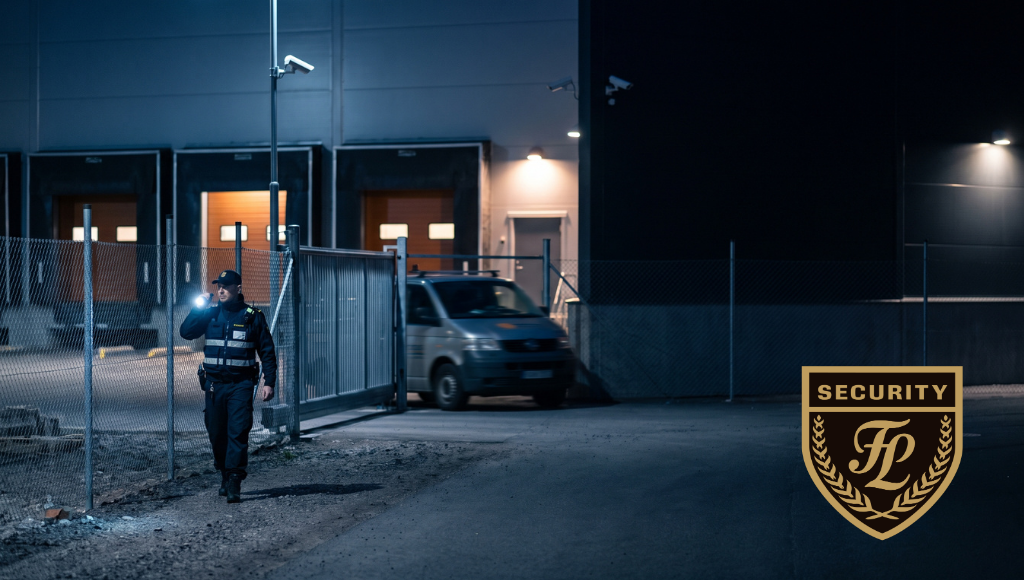
During the day, business premises are usually busy. Employees come and go, goods are delivered, vehicles move around the site, contractors carry out their work, and visitors may arrive. This human presence provides an additional layer of oversight in itself — someone is likely to notice a suspicious person, an open gate, damage, or an unusual situation.
At night, the situation changes.
A construction site may be left almost empty, goods may remain in a warehouse with no employees present, while only a few shifts may be operating across a large industrial site. As the flow of people decreases, so does the likelihood that a problem will be noticed immediately.
This is where night security becomes particularly important. Its purpose is not merely to respond to theft. Professionally organised security helps maintain control of the site, identify unusual situations, and ensure that appropriate action is taken when a security incident or technical problem occurs.
Why do sites become more vulnerable at night?
One of the most important factors is very simple — there are fewer people on-site at night.
If dozens of people work on business premises during the day, various situations are noticed naturally. At night, this additional layer of supervision may disappear almost entirely.
Darkness and reduced activity can also create more favourable conditions for people attempting to gain unauthorised access. This can be particularly relevant in remote locations, construction sites, industrial facilities, and places where valuable goods, materials, or equipment are stored.
Several risks require particular attention during the night:
- unauthorised access to the premises;
- theft of materials, tools, fuel, goods, or equipment;
- vandalism and property damage;
- unauthorised vehicle movement;
- unlocked doors, gates, or other access points;
- technical faults and other unusual situations;
- signs of fire, water leaks, or other hazards.
It is important to understand that security cannot prevent every possible incident. Its key value lies in increasing oversight of the site and helping to identify situations that require action more quickly.
What does on-site night security involve in practice?
Night security duties are tailored to the specific characteristics of each site. A small warehouse and a multi-hectare industrial facility will naturally have very different security requirements.
Before arranging security services, it is therefore important to understand what needs to be protected, where the most vulnerable areas are located, and how different situations should be handled.
Access control
One of the main responsibilities of security personnel may be controlling the movement of people and vehicles.
If a company also operates at night, a security officer may need to verify who is authorised to enter or remain on the premises, record vehicles entering and leaving, or control access to restricted areas.
This is especially important at sites shared by several companies, locations visited by freight vehicles, or premises that include restricted-access zones.
Regular site inspections
Having a security officer stationed at a single post is not always sufficient. Regular inspections are important at larger sites.
During a patrol, the security officer can check whether gates and doors are closed, the perimeter fence is intact, no unauthorised persons are present, there are no visible signs of forced entry, and no other unusual situations have arisen.
A well-organised patrol route covers the site's most important points rather than amounting to an unstructured walk around the premises.
CCTV and on-site security complement each other
CCTV is an essential element of modern site security, but cameras and on-site security personnel perform different functions.
Cameras provide visibility across multiple areas, record events, and, in certain situations, help identify suspicious activity at an early stage. However, the effectiveness of CCTV also depends on how monitoring and responses to observed events are organised.
For example, a camera may show an unauthorised person standing near a warehouse door. Specific action must then be taken in accordance with the site's security procedures.
For this reason, the most effective solution at many sites is a combination of several security measures: CCTV, alarm systems, access control, and suitable on-site guarding or mobile response services.
Checking gates, doors, and rooms
Some security incidents begin with what may seem like a minor mistake. For example, a side door may be left unlocked after the working day, a gate may not be fully closed, or a window may have been left open.
Depending on the site, night security duties may therefore include scheduled checks.
A security officer can inspect designated entrances, gates, rooms, and areas of the premises in accordance with an established procedure. If an irregularity is discovered, it is documented and, where necessary, reported to the responsible person.
This approach is also valuable because it makes security systematic. It no longer depends solely on whether the last employee leaving for the day remembered to check every entrance.
What happens in the event of an alarm or incident?
When choosing a security service, one of the most important questions is not only “What is being monitored?” but also “What will happen if something goes wrong?”
The security response to an incident should be clearly defined.
Depending on the situation and the site-specific security instructions, it may be necessary to investigate the cause of an alarm, notify the responsible person, restrict access to a particular area, or call the appropriate emergency services.
It is essential that security personnel have a clear response procedure.
For example, movement within warehouse grounds outside working hours, an activated alarm, and signs of smoke in a building are three different situations requiring three different responses.
When does night security become particularly necessary?
Not every site requires a security officer to be present throughout the night. In some cases, technical security systems combined with periodic mobile patrols are sufficient. In other situations, a permanent human presence is far more appropriate.
Several indicators suggest that a company should assess its need for night security.
Valuable equipment or materials are kept on-site
Construction machinery, power tools, metals, fuel, electronics, finished products, and other valuable goods can increase the risk of theft.
The situation at construction sites changes constantly. At one stage of a project, relatively few valuable items may be present, while just a few weeks later the site may contain expensive equipment and materials.
The security solution should therefore be reviewed periodically as the site develops.
The site is in a remote location
If there are no residential buildings, other businesses, or regular pedestrian and vehicle traffic nearby, suspicious activity is less likely to be noticed by anyone in the surrounding area.
In these circumstances, both on-site security and regular mobile patrols can play an important role.
The site has already experienced security incidents
A previous break-in, theft, act of vandalism, or repeated attempts to enter the premises are serious signs that the existing security system should be reviewed.
It is important not only to increase the security presence but also to analyse how the incident was able to occur.
Was the perimeter fence damaged? Was there a blind spot on the premises? Did the cameras fail to cover the relevant area? Was the alarm noticed too late?
The answers to these questions help create a more targeted security solution.
Vehicle or employee movement continues at night
Night security is not necessary only at completely empty sites.
Logistics centres, manufacturing facilities, and warehouses may operate around the clock. In such situations, one of the main objectives is to distinguish authorised movement from unauthorised activity.
Who is allowed to enter the premises? Which area may a particular vehicle access? Has the visitor been registered? Is the person authorised to enter the warehouse?
The more complex the movement at night, the more important well-designed access control becomes.
Night security at a construction site
Construction sites have several distinctive characteristics. The layout changes regularly, equipment and materials belonging to various subcontractors are kept on-site, and temporary fencing and access points do not always provide the same level of protection as permanent buildings.
The risks also change throughout the different stages of construction.
Night security at a construction site may include perimeter inspections, checks of machinery storage areas, access control, and regular patrols.
It is important for the security plan to evolve together with the construction site itself.
Night security at a warehouse
At a warehouse, the main risk is often related to the value of the goods stored inside and the movement of vehicles.
Security requirements may be particularly high if the warehouse contains high-value goods or items that can be easily resold.
Protecting the building alone is not enough. Loading areas, gates, the yard, and vehicle movements must also be controlled.
If the warehouse operates around the clock, security personnel must also be able to distinguish normal business operations from potentially suspicious activity.
Night security across business premises
Business premises may include administrative buildings, production facilities, warehouses, car parks, equipment areas, and several access points.
For this reason, applying one identical security measure across the entire site is not always the most effective approach.
The security plan can be divided into zones. For example, permanent access control may be provided at the main entrance, while more remote parts of the premises are inspected during regular patrols and monitored by CCTV.
This makes it possible to focus resources where they are genuinely needed.
Permanent night guarding or periodic patrols?
This is one of the most important questions for a company seeking to improve site security.
Permanent guarding means that a security officer remains on-site during specified hours. This solution may be more suitable when continuous access control is required, there is significant activity on the premises, valuable equipment is stored on-site, or the site has a higher risk profile.
Its main advantage is a continuous human presence and the ability to identify situations within the guarded area quickly.
Periodic night patrols, on the other hand, mean that the site is inspected at specified intervals or in accordance with an agreed schedule.
This can be suitable for lower-risk sites that do not require continuous access control and already have alarms, CCTV, or other security systems in place.
Periodic patrols may be more cost-effective, but there is no permanent physical security presence on-site between inspections. The decision should therefore not be based solely on the price of the service.
Night security is not only about responding to theft
When people think about security, their attention often turns automatically to preventing theft. In practice, however, night-time monitoring serves a broader purpose.
During a patrol, a security officer may notice a damaged fence, an open door, signs of a water leak, an unusual smell, smoke, an unauthorised vehicle, or another irregular situation.
A security officer does not replace a maintenance specialist or the emergency services, but they may be the person who identifies the problem and initiates the established response procedure.
At night, when almost no one else is present on-site, early detection can be especially important.
Frequently asked questions about night security
Does every company need on-site security at night?
No. The need depends on the site's risk profile, location, type of operations, the assets kept on the premises, and the security systems already installed. At some sites, an alarm system, CCTV, and periodic patrols are sufficient, while others require a permanent security presence.
How can you tell whether the existing security measures are insufficient?
Repeated incidents, unauthorised people entering the premises, problematic access points, blind spots, or significant changes in the company's operations and the value of assets kept on-site may all indicate that the security solution should be reviewed.
Is night security only necessary at large sites?
No. Site size is only one factor. A small site may also be high-risk if valuable goods are stored there or if it is located in a remote area.
Conclusion: the security solution should reflect the actual level of risk
Business activity decreases at night, and so does the natural level of oversight across the premises. At construction sites, warehouses, manufacturing facilities, and other business premises, this may increase the likelihood that unauthorised access, damage, or another unusual situation will not be noticed quickly enough.
Night security helps address this lack of oversight. Access control, site inspections, regular patrol routes, CCTV monitoring, and clearly defined incident response procedures form a complementary security system.
However, there is no single solution suitable for every site.
Permanent on-site guarding may be more appropriate for high-risk premises. At a lower-risk site, periodic night patrols combined with technical security systems may provide an adequate level of protection.
Before making a decision, it is therefore worth assessing not only the cost of security services but also the site's location, the assets stored there, access points, night-time activity, and the potential consequences of an incident. The right security solution is not simply a person stationed at the gate — it is a carefully designed system in which monitoring and response procedures are tailored to the actual risks of the specific site.
Contact Us
Mobile: +371 27788250
Email: feratum.life@inbox.lv , info@feratum.life